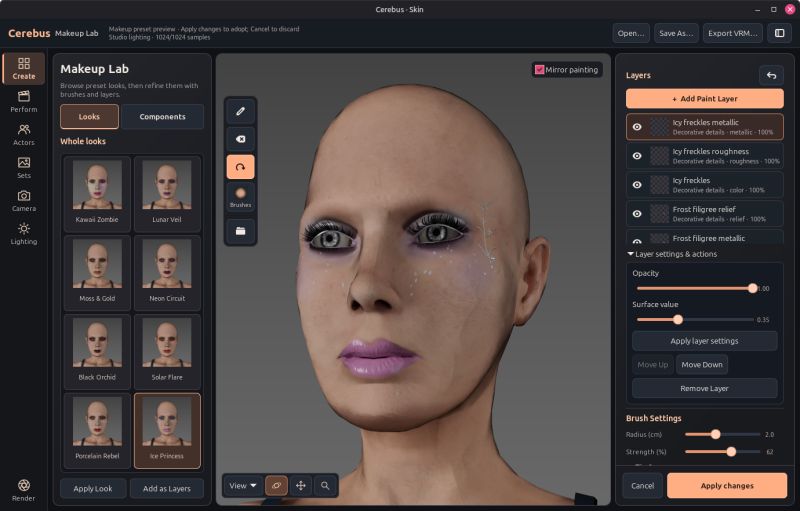
I worry that people might get the impression that I don't like doing art direction. I actually enjoy it very much, even if I am hand-holding a socially awkward synthetic wordbrain through the process.
But you have to understand the context. In the space of a week, my agents produced a project that, five years ago, I would have estimated at around eleven man-years of C++ development. Fairly well polished, and all the tests pass.
And I really enjoy that as far as the code goes, I now have the luxury of doing correctness correctly, rather than having to negotiate with the clock about what pieces of correct we do correctly on this project, at this point in time, with budgets and timescales and deliverable quality constraints being what they are. It's NICE!
It started last week when I had a thought that went something like this.
"Oh cool, a new generation of iClone and Character Creator! I want to play with it! I should... oh wait, no. It doesn't run on Linux or Mac. Also, do I really want to pay another $5,000 to buy into the ecosystem again, upgrade all of the mini apps, and guilt-buy new assets again? I do have a strong Nvidia GPU now, or actually several of them, and I suppose could... oh, wait, what is this? Microsoft has released the source code to their tangentially related 3D Movie Maker, and the code is old enough to drink. Nice. But would it need an f*ton of work to get it ready for modern projects? Yes, probably. Worth it? No, but think about the vibe! It's so friendly. Oooh, and what if I could make a character builder for it too? There aren't many good apps for character creation, and I have ideas!"
Naturally, I mean, I had to at least try to do it.
The difference between vibe coding and more serious professional engineering isn't how you arrive at the idea, but rather how you ingest and process that information. The idea can be sane, or perfectly ridiculous. The process does not care. Good planning is translating the requirement into coherent, reasonable specifications that can be clearly read, reasoned through, and validated.
So I made a plan, several actually, took me about three days to get it written up. It detailed what needs to be done, how I would do it better than any existing project ever, what features from which OSS apps need to be migrated and recreated in Zig (because Zig is cool), and how to get there.
Then I passed it into Gargoyl3 (because it sits on your repositories and waits), my shiny new, but at the time untested factory app that I'm designing for the new agent system I'm building at the same time as all of this, and waited for the friendly animated cat cartoon I'm calling an orchestrator to finish the job, yes yes.
The timeline animator, at least in its first iteration, came out okay though.
But the first version of the character making app came out of the oven, and it was a dud.
Too conventional in the approach. Not fluid enough. I started by porting MakeHuman to Zig, which went quickly, but when I started adding all the tiny little neural nets the app is going to depend on in order to do all of the things, I quickly realized that the way it's written, the meshes can't really be replaced in a reasonable way, without losing all of the rigging work that made the app an interesting target.
More of a problem with the original design than anything I did.
But that's the problem I'm learning I have with observational migrations. Reverse engineering means replicating decisions, and reasoning, priorities, and bugs you might not be aware of.
Lesson learned: Keep feature grabs small and reusable.
So I tried again, this time, using UMA as the baseline, which turned out to be a lot more flexible. Custom render system, lighting, timelines, animation, normals, texture painting, weight painting, all work.
Except that the whole thing was designed with the visual design sensibilities of an unfathomably complex probability calculator... that doesn't have a great understanding of how people use these things. Also interesting.
Now I'm 80% of the way there, across both systems, and I need to go through the thousands of moving pieces, forms, mini apps, labs, and make sure it all makes sense.
And the next thing I'm going to do is take Codex aside, and say, "Great job buddy. Let's review this tutorial on how to draw eyebrows."
It's a lot.